

If you are comparing vegan leather belt vs real leather belt, the biggest difference is usually how each one fits into your everyday life. How often will you wear it? How long do you want it to last? And how much do material, price and care matter to you?
Vegan leather has changed a lot in recent years and is no longer limited to stiff, shiny finishes. Real leather varies just as much, especially when you compare lower grades with full-grain options.
This guide looks at how both types of belts are made, how they wear over time, what they cost and where each one makes more sense.
We will compare durability, sustainability, look and feel, care and long-term value, so you can work out which option suits you best.
What Is a Vegan Leather Belt Actually Made From?
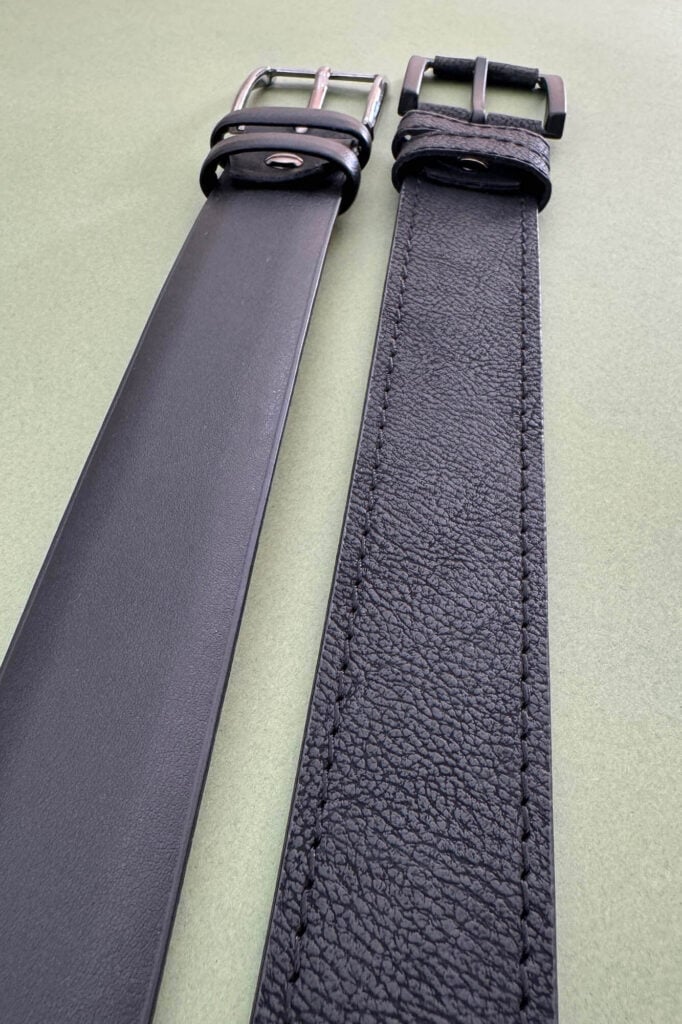
Vegan leather is not a single material. Most vegan leather belts sold today are made with a polyurethane (PU) coating applied over a fabric or fiber backing. This has largely replaced the PVC commonly used in older types of “pleather”.
PU is generally more flexible than PVC, does not yellow as easily and can be embossed with a more realistic grain. As a result, a modern vegan leather belt can look very close to real leather when you first see it in a store. The differences usually become clearer after you start wearing it.
Some brands are also experimenting with materials made from cork, cactus fibers, apples or mushrooms. These options still make up a much smaller part of the market than PU, although they are becoming more common in accessories. The global vegan leather market was valued at USD 11.07 billion in 2025 and is expected to reach USD 27.80 billion by 2034, growing at an annual rate of 10.8% (Custom Market Insights, 2025).
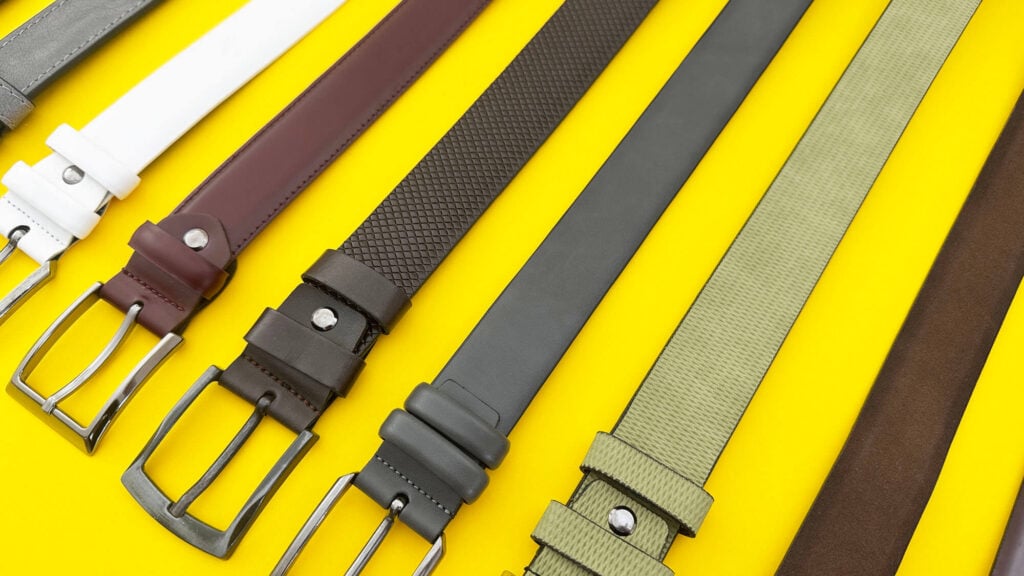
This growth has brought better finishes, more realistic textures and a wider choice of styles. You can see some of these changes in our vegan leather belt collection, particularly in the materials and hardware now available.
Real leather starts with animal hide. The hide is tanned, processed and cut, and the final quality depends heavily on which part and layer are used. We explain the different grades in our guide to full-grain vs. genuine leather belts, because the words “real leather” alone say very little about the quality.
Quick Material Snapshot
| Vegan Leather Belt | Real Leather Belt | |
| Base material | Polyurethane (PU), sometimes PVC or plant-based fibers | Animal hide, including full-grain or split leather |
| Feel | Smooth and more uniform | Natural grain with slight variations |
| Typical lifespan | 2 to 5 years | 15 to 20+ years for full-grain leather |
| How it ages | Surface gradually wears down | Develops a patina |
| Typical price | $20 to $60 | $50 to $150+ |
| Water resistance | Usually better at first | Needs conditioning to maintain water resistance |
How Long Does Each Belt Actually Last?
The lifespan is very different:
- PU vegan leather belt, around 2 to 5 years with regular wear
- Higher-quality microfiber PU, sometimes 6 to 7 years
- Full-grain leather belt, 15 to 20 years or more with basic care
The reason is mainly in how the materials wear out.
A PU belt has a synthetic coating over a backing material. After years of repeated bending, especially around the buckle holes, that outer layer can begin to crack or peel.
Full-grain leather wears differently. It may soften, crease and pick up marks over time, but there is no separate surface coating to come away from the material underneath. This allows the belt to keep bending in the same places for many years.
Wear tests show a similar difference. In Martindale abrasion testing, good-quality leather can withstand four to five times more abrasion cycles than average PU before visible damage appears.
Climate can also affect how long a belt lasts. Heat and humidity can speed up the breakdown of PU, while regular conditioning helps real leather stay soft and flexible.
Wondering why there is such a big difference in price? Our guide to why expensive leather belts are worth the investment explains what you are paying for and how that affects the lifespan of the belt.
Which Belt Actually Costs More Over Time?
A vegan leather belt costs less upfront, but that does not always make it the cheaper option in the long run.
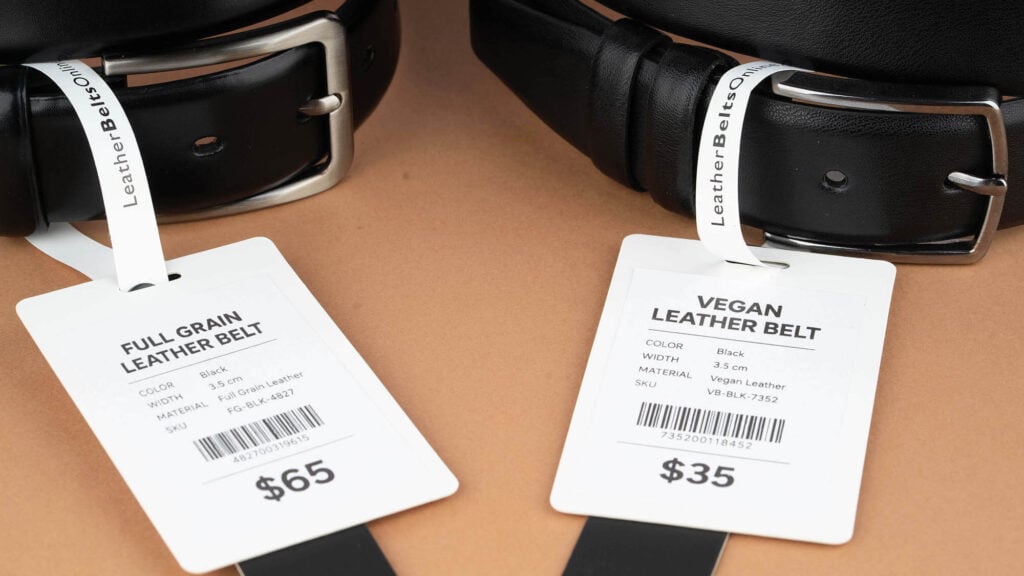
Take a $30 vegan leather belt that lasts three years. That works out to about $10 per year. A $90 full-grain leather belt worn for 18 years costs around $5 per year.
The difference comes down to how often each belt needs replacing. Over 18 years, you may go through several PU belts, while a good full-grain leather belt could still be in use.
For someone who wears a belt several times a week, the higher price of real leather can start to make sense within the first few years. If you replace the vegan belt twice while the leather one is still going strong, you have already spent about the same amount.
This is why the lowest price at checkout does not always mean the lowest cost over time.
Which One Is Actually Better for the Environment?
There is no clear winner because every material comes with an environmental cost. The main differences are in how each one is made and how often the belt needs replacing.
- Real leather usually lasts much longer, so one belt may stay in use for 15 or 20 years. The tanning process still has an environmental impact, especially when chrome-based methods are used.
- PU vegan leather avoids animal materials, but it is made from plastic-based polyurethane. It does not biodegrade and usually needs replacing sooner.
- Plant-based alternatives, such as cork and cactus fiber, may offer another option, although there is still less evidence on how well they hold up after years of regular wear.
This is why lifespan matters as much as the material itself. A belt kept for many years may have a lower overall impact than one replaced every few years, since every replacement involves more production, packaging and shipping.
For buyers who place sustainability first, plant-based materials are worth watching, especially as more options become available and their long-term durability becomes clearer.
Which One Looks and Feels More Premium?
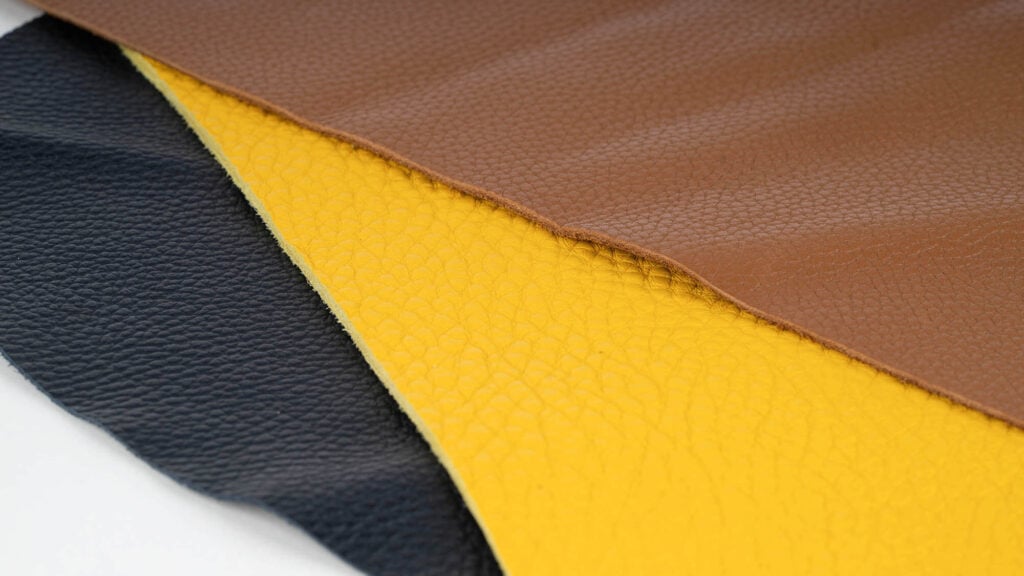
For most buyers, full-grain leather feels more premium because the surface has natural variation and changes over time. With regular wear, it softens, darkens slightly and develops a patina, so the belt gains character instead of simply looking older.
PU vegan leather usually has a smoother, more uniform finish. It can look very clean when new, especially from a distance, but the difference often becomes clearer with use. Scuffs tend to show more on the surface, particularly on lighter colors, and once the coating starts to crack or peel, the belt looks worn quite quickly.
The feel is another clue. Real leather is usually less uniform to the touch, while PU feels smoother and more consistent.
Not sure what material you are looking at? Our guide to 5 tests for telling real leather from fake explains what to check around the surface, edges and smell.
How Do You Care for Each Type of Belt?
A real leather belt needs more regular care. Every few months, apply a small amount of leather conditioner to keep it soft and prevent it from drying out. When you are not wearing it, hang it by the buckle and keep it away from direct sunlight or heat.
If the belt gets wet, let it dry naturally. Radiators and other heat sources can make the leather stiff and dry.
A vegan PU belt is easier to maintain. In most cases, wiping it with a damp cloth is enough, and there is no need for conditioner.
The main difference is what happens once the belt starts to age. Real leather can often be cleaned and conditioned for years. With PU, once the surface begins to crack or peel, there is very little you can do to repair it.
For more detailed advice, our guide to caring for leather belts covers conditioning, storage and the mistakes that can shorten a belt’s lifespan.
When Does a Vegan Leather Belt Make More Sense?
A vegan leather belt makes the most sense when animal-free materials are a priority. In that case, the choice is straightforward.
It can also work well for occasional wear. A belt used only a few times a month is under much less stress than one worn every day, so the shorter lifespan of PU becomes less important.
The lower upfront price is another advantage. If you need a belt without spending more on full-grain leather, a well-made PU option can be a sensible choice.
Vegan leather is also easy to maintain. A quick wipe with a damp cloth is usually enough, and the consistent colors and finishes can make it easier to find a belt in the exact shade you want.
Which One Should You Actually Buy?
After comparing the two materials, the choice is fairly simple:
- Choose full-grain leather for regular wear, long-term durability and better value over many years.
- Choose vegan leather for animal-free materials, occasional use or a lower upfront price.
Whichever option you choose, quality still matters. With vegan leather, look for PU over a cotton or canvas backing rather than PVC. Check the edges too: real leather should look solid through the cut, while a good vegan belt should have clean, sealed edges with no fraying.
For most people buying a belt for everyday use, full-grain leather is the stronger long-term choice. Vegan leather makes more sense when your priorities are different.
Ready to choose? Browse our full-grain leather belt collection or explore our vegan leather belt collection.
Frequently Asked Questions
Not usually. A PU belt often lasts 2 to 5 years. Full-grain leather can last 15 years or much longer if it is looked after properly. Most of the wear shows up where the belt bends every day, especially around the buckle holes.
That depends on the material. PU is animal-free, but it is also plastic-based and tends to wear out sooner. Real leather has its own environmental impact, particularly during tanning, although one well-made belt can remain in use for many years. How often you replace the belt matters too.
Often, yes. Real leather rarely feels completely uniform. You may notice small changes in the grain or texture as you run your hand across it. PU is generally smoother and more even. You can also check the edges and smell, as explained in our guide to spotting real leather.
It can, especially in the areas that bend the most. The first signs often appear near the buckle holes, where the PU surface may begin to split or peel. Full-grain leather is more likely to soften, crease and pick up marks as it gets older.
A vegan leather belt will usually cost $20 to $40, while full-grain leather is more often in the $60 to $150 range. So PU is clearly cheaper at first. The difference can narrow over the years, though, especially if the leather belt lasts long enough to replace several cheaper ones.
Not really. Most PU belts just need a quick wipe with a damp cloth. No conditioner or special treatment is required. The harder part is what happens once the surface begins to wear out. Cracks and peeling cannot really be repaired, so at that point, replacing the belt is usually the only option.