When you shop for a leather belt, the price difference can be confusing. You might see a belt stamped “Genuine Leather” for $25, then find a full-grain leather belt selling for five times more.
At first, they can look similar. Both are made from real leather and both may seem good enough on the rack. But the difference is in the material itself.
A full-grain vs. genuine leather belt comparison comes down to three things: which part of the hide is used, how much the leather is processed and how well the belt holds up with regular wear.
In this guide, we’ll explain why full-grain leather costs more, why it usually lasts much longer, and why the label “genuine leather” doesn’t always mean what shoppers think it means.
What “Genuine Leather” Actually Means (It’s Not What Most People Think)?
The phrase “genuine leather” sounds better than it really is. Many shoppers see it and think it means high-quality leather. In most cases, it simply means that the belt is made from real animal hide, not synthetic material.
That is useful to know, but it does not tell the whole story. The label does not explain which part of the hide was used, how the leather was treated or how long the belt will last.
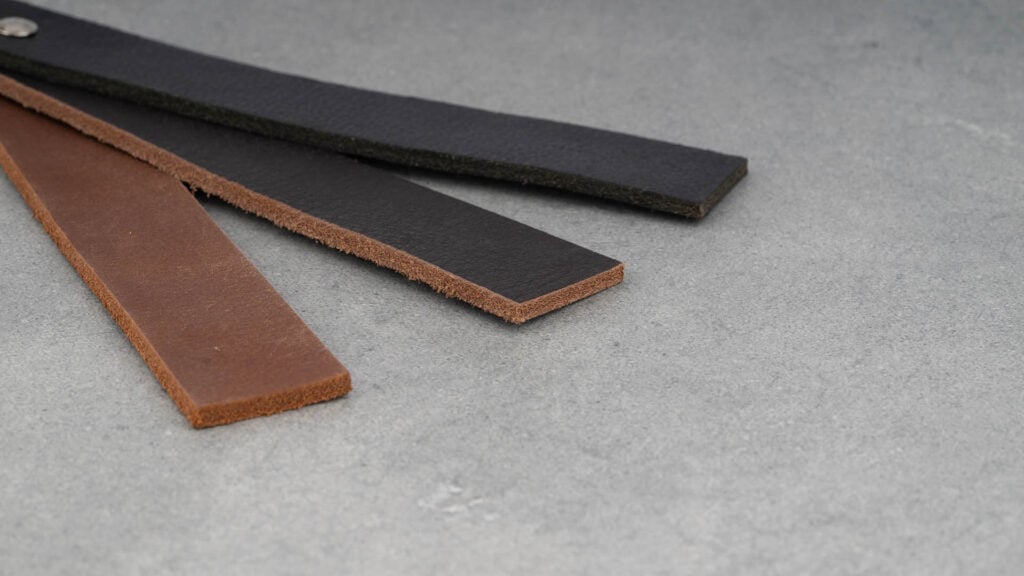
A hide is made of different layers. The strongest part is the outer layer, where the fibers are tighter and more compact. This is where full-grain leather comes from.
Once that outer layer is removed, the inner layers are softer and less resistant. Many belts labelled “genuine leather” are made from these inner layers. They are still real leather, but they usually need more processing to look smooth and uniform.
Manufacturers may add coatings, bonding agents or stamped grain patterns to improve the appearance. The belt can still carry a “Genuine Leather” label because the material is real hide. But it is not the strongest part of the hide.
This does not mean every genuine leather belt is a bad purchase. A well-made one can still be fine if you only wear it occasionally. For everyday use, though, it is in a different category from a full-grain leather belt.
The key difference is simple: full-grain leather keeps the strongest outer layer intact, while genuine leather usually comes from weaker inner layers. That is why full-grain belts tend to last longer, hold their shape better and age more naturally.
What Makes Full-Grain Leather Different?
Full-grain leather feels different because its surface is left as natural as possible. It is not sanded down to remove small marks, pores or uneven areas, so every belt has a slightly different look.
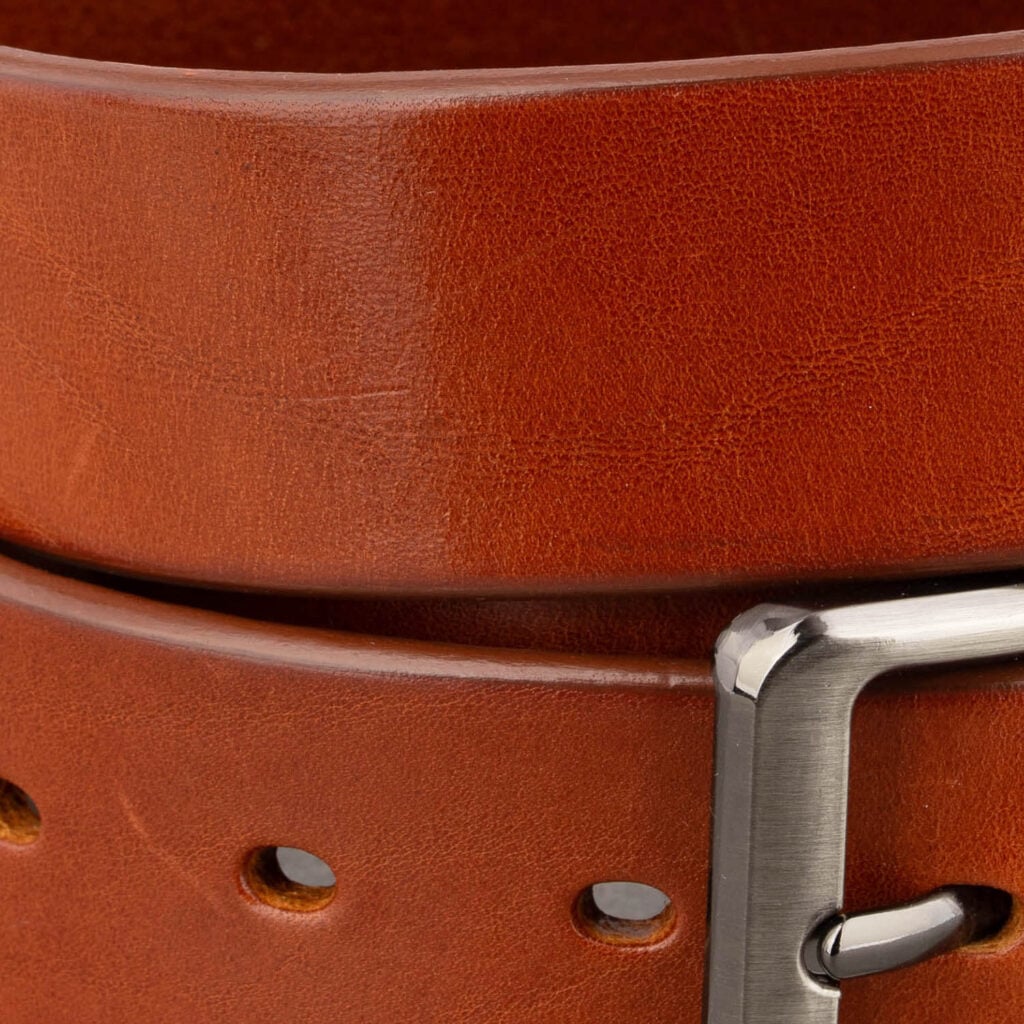
This natural surface also changes the way the belt ages. Full-grain leather is not sealed under a thick synthetic coating, so it can absorb conditioner and natural oils from daily use. Over time, it becomes softer, slightly darker and more lived-in. This is what creates the patina people often look for in quality leather.
A genuine leather belt usually does not age in the same way. Its surface may look smooth when new, but the finish can wear down with regular use. Around the buckle holes, where the belt bends and pulls the most, this often shows up as stretching, cracking or peeling.
The tanning method can make a difference too. Vegetable-tanned full-grain leather often feels firmer at first, but it keeps its shape well and develops more character the longer you wear it.
For an everyday belt, that is the main advantage: full-grain leather does not just last longer, it usually looks better as it ages.
For more on the trade-offs between leather types, see our breakdown of leather pros and cons for belts.
Full-Grain vs. Genuine Leather: The Key Differences
Full-grain leather and genuine leather are both real leather, but they are not the same quality. The main difference is the part of the hide used and how much processing the leather goes through.
| Full-Grain Leather | Genuine Leather | |
| Hide layer | Outermost layer, with the densest fibers | Inner split layers, with weaker fibers |
| Surface treatment | Natural grain left intact | Often coated with a synthetic finish |
| Typical lifespan | Many years, sometimes decades, with basic care | Usually wears out faster with daily use |
| Patina | Develops a natural patina over time | Does not develop the same kind of patina |
| Breathability | More breathable and able to absorb conditioner | Less breathable because of surface coatings |
| Strength | Stronger because the fiber structure is intact | More likely to stretch, crack or peel under tension |
| Cost | Higher upfront, often $50 to $150+ | Lower upfront, often $20 to $50 |
| Long-term value | Usually cheaper per year because it lasts longer | Can cost more over time if replaced often |
| Appearance | Natural markings, each belt looks slightly different | More uniform surface, often with embossed grain |
The cost difference makes more sense when you look at it over time. A $150 full-grain belt worn for 15 years costs about $10 per year. A $40 genuine leather belt replaced every two years costs about $20 per year.
So, while genuine leather is cheaper at checkout, it can become the more expensive choice if you need to replace it again and again. For a belt you wear often, full-grain leather usually offers better long-term value.
If you want a practical way to test leather before buying, our guide to 5 tests for telling real leather from fake walks you through the main ones.
How to Tell Which Leather You’re Actually Looking At?
Most product pages don’t explain which part of the hide a belt comes from. Luckily, you can usually spot the difference with a few simple checks.
Feel the surface
Run your hand across the belt. Full-grain leather usually feels slightly textured and irregular, because the natural grain is still intact.
Genuine leather often feels smoother, more uniform and sometimes slightly plasticky. If the grain pattern repeats too perfectly, it is probably embossed rather than natural.
Check the edge
Flip the belt over and look at the cut edge. A full-grain belt usually shows a clean, solid cross-section, almost like one continuous piece of hide.
Genuine leather can look more fibrous, fuzzy or layered, especially if the inner splits have been bonded together and coated.
Smell it
Full-grain leather normally has a more natural, earthy smell. Genuine leather with a heavy synthetic finish may smell more like plastic or chemicals.
This test is not enough on its own, but it can help when combined with the surface and edge checks.
The burn test
This only makes sense on a small scrap, never on a finished belt. Full-grain leather usually chars and curls without melting. Leather with synthetic coatings may soften quickly and give off a plastic smell.
Read the label carefully
Labels can tell you a lot. Terms like “full grain,” “top grain” or “vegetable tanned” are more specific and meaningful.
If the belt only says “genuine leather” with no other detail, it usually means the product is made from split leather. That does not automatically make it useless, but it does tell you it is not the strongest part of the hide.
See also: how to tell if a leather belt is real, which covers each test in more detail.
Which One Should You Actually Buy?
If you wear a belt often, full-grain leather is usually the better buy. It costs more at first, but it keeps its shape, ages better and does not need replacing as quickly.
A genuine leather belt can still make sense if you only wear it occasionally, for example with a suit or for formal events. In that case, paying extra for full-grain may not be necessary.
For daily wear, though, the difference becomes clear. Cheaper belts often start to stretch, crack or peel around the buckle holes, which are the areas under the most tension. Once you replace one or two of them, the initial saving starts to disappear.
So the choice is simple:
- choose full-grain leather for an everyday belt;
- choose genuine leather only if you need something affordable for occasional use.
One final tip: do not rely on the word “genuine” alone. Look for clearer terms like full-grain, top-grain, vegetable-tanned leather or details about the actual hide layer used.
Related reading: why expensive leather belts are worth the investment and our overview of the best types of leather for belts.
Frequently Asked Questions
No. Genuine leather and full-grain leather are both real leather, but they come from different parts of the hide.
Full-grain uses the strong outer layer, where the fibers are tighter and more compact. Genuine leather usually comes from the inner split layers, which are weaker and often need extra finishing to look smooth.
Genuine leather often has a synthetic coating on the surface. That coating can block conditioners from reaching the leather fibers underneath.
With daily wear, especially around the buckle holes, the surface can dry out, stretch, flake or crack. Full-grain leather does not rely on the same kind of coating, so it usually ages more naturally.
Check the surface, edge and label.
Full-grain leather usually has a slightly irregular grain, a solid cut edge and a natural leather smell. If the grain looks too perfect or repeats in a pattern, it may be embossed.
If the label only says “genuine leather” and does not mention full-grain or top-grain, it is probably a lower grade.
No. Genuine Italian leather usually refers to leather made in Italy, so it points to origin, tanning tradition and craftsmanship.
Genuine leather, instead, is a product grade. It usually describes leather made from the inner split layers of the hide, regardless of where it was produced.
Condition it every 3 to 6 months with a natural conditioner, ideally lanolin or beeswax-based. If it gets wet, dry it gently and let it air out.
Store it hanging by the buckle, and avoid folding or rolling it tightly. For the full routine, see our guide on caring for leather belts.
The Bottom Line
Both types are real leather, but that’s not the real difference.
What matters is which part of the hide you’re getting and how the belt will look after years of use. Full-grain leather comes from the strong outer layer, handles daily wear better and develops a natural patina over time.
Genuine leather usually comes from the inner layers. It can look fine at first, but with regular use it is more likely to stretch, crack or peel within a few years.So, if you buy cheaper belts and replace them every couple of years, that is a choice. But in the long run, it is usually not the cheaper one.
Full Grain Leather Belts
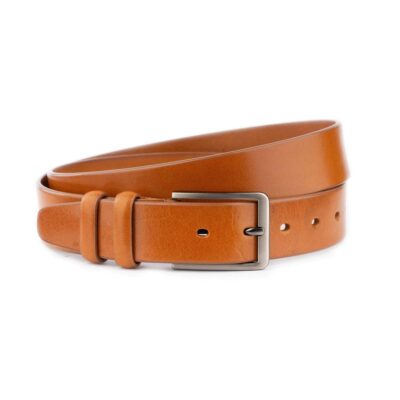
Tan Full Grain Leather Belt For Men 3.5 cm
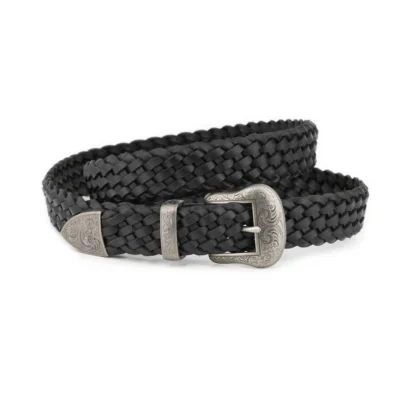
Original price was: $65.00.$55.25Current price is: $55.25.Western Woven Belt Black Leather With Silver Buckle
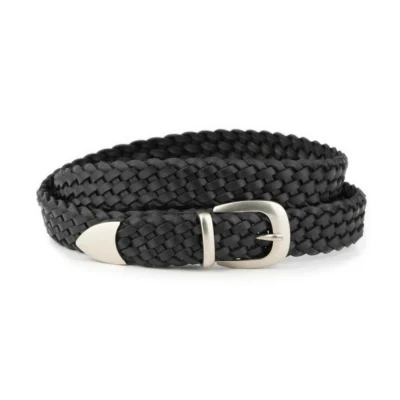
Original price was: $95.00.$61.75Current price is: $61.75.Western Braided Leather Belt – Black With Silver Buckle
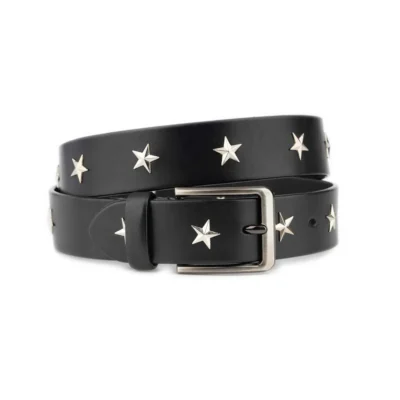
Original price was: $75.00.$60.00Current price is: $60.00.Black Leather Belt with Silver Star Studs
Original price was: $180.00.$144.00Current price is: $144.00.Black Studded Grommet Belt With Stainless Steel Buckle
Original price was: $295.00.$250.75Current price is: $250.75.Black Western Belt – Full Grain Stitched Leather With Silver Buckle
Original price was: $75.00.$67.50Current price is: $67.50.Western Belt Black Full Grain Leather With Silver Buckle
Original price was: $75.00.$67.50Current price is: $67.50.Western Belt With Silver Buckle – Black Full Grain Leather
Original price was: $85.00.$68.00Current price is: $68.00.